Off the Bricks

Pack 00 · FREE

A Free Fire Alarm Box Walking Hunt in Downtown Boston

Boston's red fire alarm boxes aren't decoration. In 1852 this city switched on the world's first municipal fire alarm telegraph, and the network those boxes belong to has been running ever since - on its own wires, separate from the phones. When 911 went down in December 2018, a North End resident reported a fire by pulling one.

The 1852 Hunt is a free, self-guided walk through that network and the fires around it. It starts at Government Center, a block from where the first alarm office worked, and runs through Downtown Crossing to the corner where the Great Fire of 1872 began. You'll stand where its first alarm went in - about a quarter of an hour late - and find out why the usual story about a missing key doesn't match the inquiry's own testimony - the officer who opened the box had his key in his pocket - and why the real cause is still an open question. Then on to the spot where the fire was stopped, the square it created, a firehouse built into a skyscraper, and an old double-company firehouse in Fort Point.

It's thirteen stops, about two hours and three kilometers, flat and step-free. Each stop is a riddle that walks you to the next corner, and the answer is something you can only get by looking: usually the number on a real alarm box, read from the sidewalk. Then you get the story, with its sources.

Every fact comes from a primary record or a named source - the 1873 commission report on the Great Fire, the 1889 fire department history, the Boston Fire Historical Society, the City's own box data - and every source is listed. Where the sources disagree, we say so.

The 1852 Hunt is one of two free walks in Off the Bricks: Boston Hunts, made with Alarm Club, the game where Bostonians check the City's fire alarm box list on foot. Neither is affiliated with the City of Boston or the Boston Fire Department. Never touch, open or stick anything on a box. Read it and move on.

Free. No account. Start at Government Center.

The whole walk is free in the app.

Route

01020304050607080910111213
Map data © OpenStreetMap contributors
  • The whole walk

    120 MIN · 3 KM · 13 STOPS
  • The short cut: the Great Fire

    50 MIN · 1.3 KM · 6 STOPS

    The Great Fire of 1872 in under an hour: where it started, the box that was late, the sick horses, where it stopped, and the half-built post office it couldn't get through.

Stop 01 · Downtown

Before it took a single real alarm, Boston's fire telegraph rang the city's bells from New York.
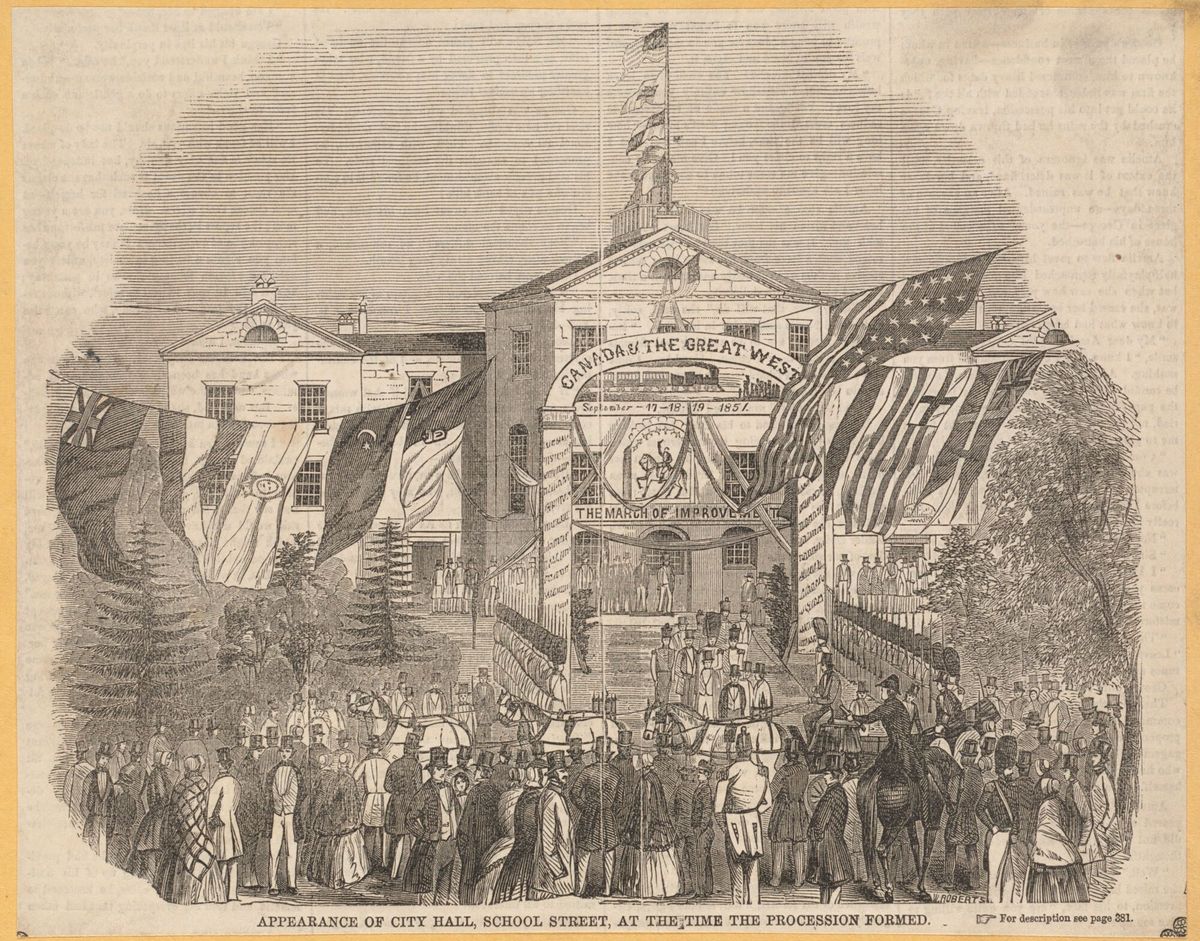
Engraving of City Hall on School Street, 1851 - the building on School Street before the 1865 City Hall, in the system's first years.
W. Roberts, 'Appearance of City Hall, School Street, at the time the procession formed,' 1851. Boston Public Library, Arts Department, via Digital Commonwealth.

Before Boston's fire alarm telegraph took a single real alarm, it rang the city's bells from New York. The 1889 department history says the idea was first written off as 'a visionary or "cranky" scheme,' until Mayor Josiah Quincy pushed the council to look into it. Moses Farmer built bell-striking machines, one hung in the old City Hall belfry and wired to New York, and an operator there rang Boston's bells - which, the history says, 'caused a false alarm of fire.' The city put up $10,000 for 'an experiment, being without precedent in the world,' and at noon on April 28, 1852, switched on the world's first municipal fire alarm telegraph. It ran from an office in the City Building at Court Square and Williams Court - the lane people now call Pi Alley, just past Old City Hall. The first real alarm came the next night, April 29, at 8:25. In December 1865 the office moved about a hundred feet, to the top of the new City Hall at 45 School Street, where the 1889 history puts it 'in the dome.' It stayed until 1895, and has been at 59 Fenway since 1925.


Look now

Look down School Street to Old City Hall's mansard roof - the alarm office worked under it from 1865 to 1895.

Read more
Early System Design and Construction - Boston Fire Historical Society

Stop 02 · Downtown Crossing

Boston's first keyless alarm box went in on this corner in 1881.

For the first thirty years you could not just pull a Boston fire alarm. The boxes were locked. Keys went to what the Boston Fire Historical Society calls 'trusted citizens in the area'; everyone else had to find a keyholder first. An 1855 ordinance put a committee in charge of who was 'intrusted with the care of the keys of the signal-boxes,' and fined false alarms two to fifty dollars. It didn't hold - the 1889 department history says every lock was later changed 'on account of the keys being held by irresponsible people and frequent false alarms.' This corner has been in the paperwork a long time. The Great Fire inquiry of 1872 mentions 'Box 42, on Winter street.' And a history of the system by Joe Maurath records the first keyless door, a T-handle, going onto Box 42 at Tremont and Winter on April 16, 1881. Two weeks later the boxes were ordered painted red. Until then they were black. The last locked box in Boston was gone by October 1907. Today's box here carries four digits - your answer.


Look now

Look at the door on the box in front of you - nobody needs a key to raise an alarm on it. That started here. Look, don't touch.

Read more
History of the Boston Fire Alarm Telegraph System - Joe Maurath (1997)

Detours

  • Station 7, Cooper Street
    From Milk and Federal, walk to State station (about 4 minutes) and take the Orange Line one stop north to Haymarket. From Haymarket it's about 5 minutes on foot: north on North Washington Street, right onto Cooper Street, one block to Endicott. Or walk the whole way, about 15 minutes. Come back to Post Office Square the same way. Subway fare applies.
  • The Office in the Fens
    From Congress and A, walk back over the Congress Street Bridge to South Station (about 10 minutes), take the Red Line two stops to Park Street, then any westbound Green Line B, C or D train to Hynes Convention Center. Walk south on Massachusetts Avenue and turn right on Westland Avenue; follow it past Hemenway Street to the Fens, about 10 minutes. The building stands on the parkland there. Exterior only - it is a working dispatch center. Stay on the public paths and away from its doors and driveway. Subway fare applies.

Pit stops

  • Restroom · NEAR STOP 01
    City public toilet across from Faneuil Hall
    A City self-cleaning public toilet on Congress Street across from Faneuil Hall, a few minutes from the Government Center start. Check it's open before you count on it.
    City of Boston, Property Management
  • Restroom · NEAR STOP 11
    City public toilet at Central Wharf
    A City self-cleaning public toilet at Central Wharf on Atlantic Avenue, by the Aquarium - about a six-minute walk north of the firehouse. Check it's open.
    City of Boston, Property Management
  • Restroom · NEAR STOP 12
    South Station temporary restrooms
    South Station's restrooms are under construction through late November 2026; the MBTA has temporary restrooms along Atlantic Ave. Check before you go.
    MBTA

46 sources